Links, servers and disks under continuous watch. The engineer is alerted before the problem reaches anyone at their desk.
Zabbix + Grafana
15 minutes
Response time
On the Critical 24/7 plan — around the clock, public holidays included. Response time is counted from the moment the request is logged.
per SLA
3-2-1
The backup rule
Three copies on two media, one of them off site — with a regular restore check on the data that matters.
restore test every month
What we do
Nine services —
one contract
You do not need one contractor for the network, another for telephony and a third for backups. One team and one SLA cover all of it.
01
Network and connectivity
The network is the foundation of IT infrastructure. When it fails, everything else stops with it. So we design for redundancy and watch its state continuously.
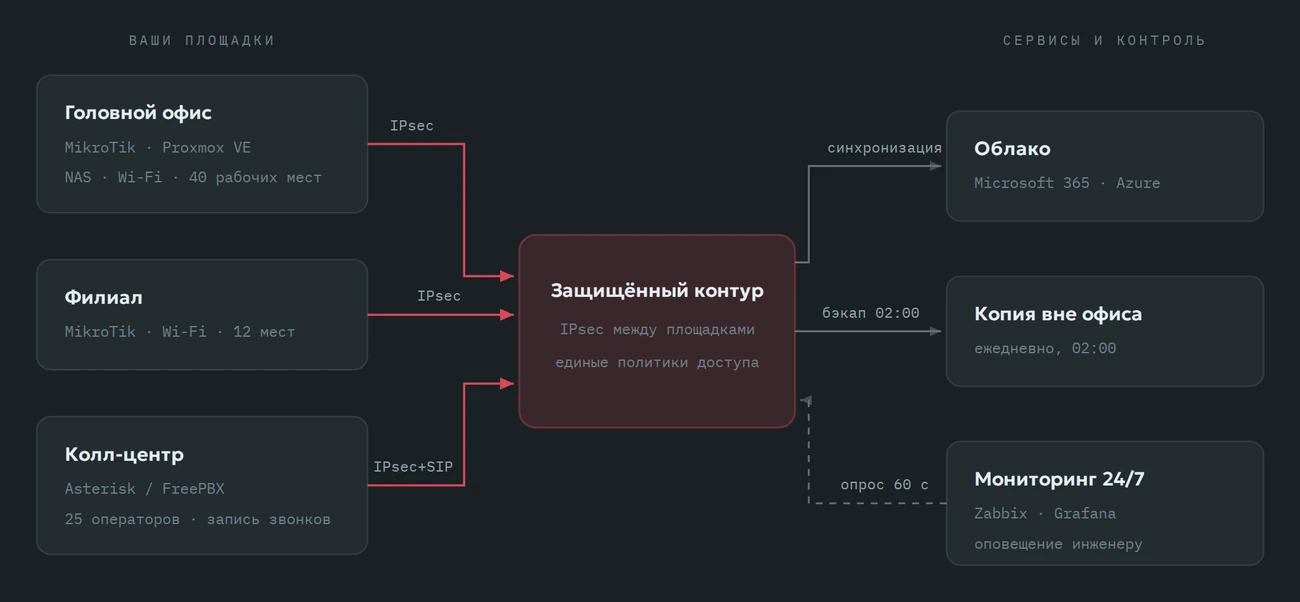
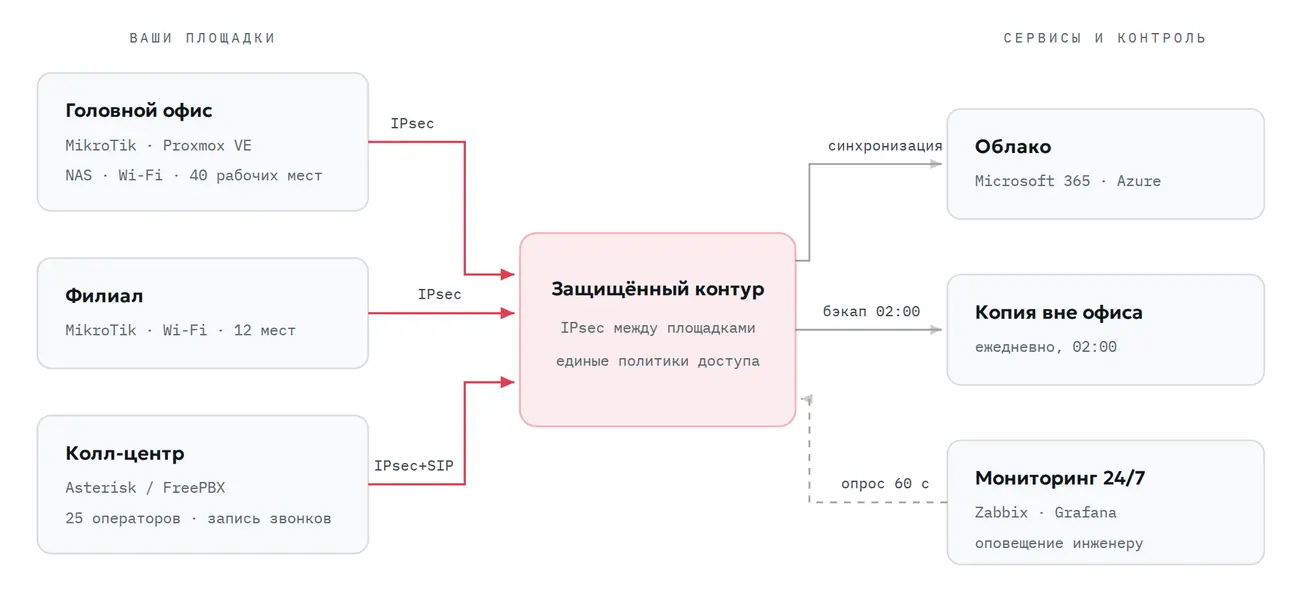
The typical layout we deploy for a company with a head office, a branch and a call centre. Each rectangle here is a separate service from the list above.
Three sites work as one network: IPsec tunnels bring them into a common perimeter with a single set of access policies, from there cloud sync and a nightly off-site copy run, and monitoring polls the perimeter every 60 seconds. The hardware and the number of sites are chosen per company.
What we promise
Infrastructure you notice
only when you look for it.
A client happy with IT is one who does not think about IT. We measure that in numbers: downtime, response time, successful restore tests. You see them in the monthly report, not only in the proposal.
The core service
A system administrator
on tap
An engineer who knows your infrastructure and is available under contract — without a line on the payroll. Most tasks are handled remotely, in minutes rather than days.
Available when needed
Fixed hours on the chosen plan, up to round the clock for critical infrastructure.
Most work is remote
We configure servers, networks, accounts and telephony remotely. A site visit is only needed for work on physical hardware.
A team, not one person
Every client has a lead engineer and a stand-in colleague who knows the same infrastructure.
A monthly report, not just an invoice
What happened, what we fixed and what is likely to break next month.
A contract or an in-house hire?
The comparison finance directors ask for most often.
In-house hire
Tekadvice contract
Monthly cost
Salary, taxes, equipment, training
A fixed fee, one invoice
Holidays and sick leave
You are left uncovered
Continuous cover under contract
Skills
One person, one skill set
Network, servers, telephony, backups
Working hours
8 hours, working days
Up to 24/7 under SLA
Hiring and replacement
1–3 months of searching
We start the same week
Paperwork
Employment contract, timesheets, leave
A service contract and a monthly statement
Technology
What we build on
We pick solutions that can be supported efficiently in Moldova: with parts you can get, support you can reach and documentation your future in-house engineer will be able to use.
Network
MikroTik
RouterOS
Ubiquiti
Cisco
TP-Link Omada
Servers
Proxmox VE
VMware ESXi
Hyper-V
Windows Server
Debian / Ubuntu
Storage
Synology
QNAP
TrueNAS
ZFS
Backup
Veeam
Proxmox Backup Server
Restic
Monitoring
Zabbix
Grafana
Uptime Kuma
Telephony
Asterisk
FreePBX
Yealink
SIP
Cloud
Microsoft 365
Azure
AWS
Entra ID
Automation
PowerShell
Bash
Python
Ansible
Data protection
A backup that
actually restores
Everyone knows the 3-2-1 rule. The difference is in the last step: once a month we bring the system up from every copy on a test bench and record how long it took. Without that step a backup is a hope, not a guarantee.
Copy 1
Local NAS
Fast recovery of a file or a whole machine without a site visit.
Copy 2
A second medium
A separate backup server — on different hardware and a different power feed.
Copy 3
Off site
Cloud or another address. For fire, theft and ransomware.
Verification
Restore test
Once a month, from every copy. The actual time to get back to work goes into the report.
How we work
Four steps —
in exactly this order
We do not start blind and we do not issue «approximate» estimates. First we look at what is there and show it on a diagram. Each stage begins only once you have signed off the previous one.
01
Audit
An inventory of hardware and licences, a network diagram, a list of risks by priority.
3–5 working days
02
Plan and quote
A staged plan, a hardware list, timescales and a fixed price for each stage.
up to 5 working days
03
Deployment
Work in an agreed window, usually at night or at the weekend. Every stage has a rollback plan ready.
to schedule
04
Support
Monitoring, updates, a restore test from the copies and a clear report every month.
monthly
The work
What it looks like
on site
Server rack
Engineer on site
The team
Who it suits
When downtime
is expensive
If the network goes down and twenty people sit idle, you can work out the cost of an hour yourself. These are exactly the cases we work for.
Call centres
Call queues, call recording, agent reports, a stable link and a backup SIP provider.
Companies with branches
One network across offices, shared file resources, the same access policies everywhere.
Retail chains
Tills, terminals, Wi-Fi for customers and staff, remote diagnosis of a location without a visit.
Manufacturing and warehouses
Wi-Fi on the shop floor and in the warehouse, data capture terminals, redundant power and links.
Plans · SLA
Three levels
of service
The plans differ not only in the list of services but in response time, support hours and the level of redundancy.
Guaranteed response time from the moment the request is logged